Somewhere in the last few years, the market for immune-support peptides quietly forked into two roads that lead to the same molecule but almost nowhere else in common. Walk down one and a licensed physician reviews your history before anything gets dispensed, a pharmacy compounds it under recognized standards, and someone is still there if something goes wrong. Walk down the other and you check a box that says the powder is for laboratory research, not human use, and the transaction ends the moment the cart empties.
Reporting on how that split happened, and what it means for someone standing at the fork today, turns out to matter more than reporting on which peptide is “best.” That question assumes the products people are comparing are equivalent except for the molecule inside. They are not. This piece works through six concrete measures of where these two channels diverge, scores them, names the providers sitting on each side, and lands on a verdict. But it starts with a disclosure that tends to get buried: most of what follows concerns compounds that are not FDA-approved for immune use in the United States, several of them compounded preparations or research-status materials. The scores below measure how much risk and accountability sit behind the product. They say nothing about whether the product works, because for most of this category, that answer barely exists yet.
What the evidence actually says, before anyone ranks anything
It helps to know what these molecules have shown in humans, because that number determines how much weight the sourcing decision has to carry. “Immune-support peptides” is a category built on a loose association, not a shared mechanism: thymosin alpha-1, LL-37, glutathione, thymulin, and VIP get grouped together mostly because someone, somewhere, tied each of them to immunity.
Thymosin alpha-1 sits well above the rest. Its synthetic version, thymalfasin, carries drug approval in more than 35 countries and works on dendritic and myeloid cells to help normalize T-cell function [1]. A 1998 randomized trial of 98 chronic hepatitis B patients found a complete virological response in 40.6% of the treated group against 9.4% of controls [2]. That is a real signal. But it thins out as the trials scale up. The much larger, double-blind TESTS trial, run across 1,089 adults with sepsis, found 28-day mortality of 23.4% on the drug versus 24.1% on placebo, a hazard ratio of 0.99, essentially no benefit [3]. A propensity-matched study of 771 COVID-19 patients turned up no mortality association either [4].
Everything else in the category has thinner footing. LL-37’s human evidence rests on one positive trial, a topical study in 34 patients with venous leg ulcers [5], set against reviews warning about cytotoxicity and autoantigen behavior tied to psoriasis and lupus [6]. Glutathione, taken orally in its plain form, barely reaches the bloodstream at all, since the gut and liver break it down first [7]. VIP had its moment tested at scale and lost it: the TESICO trial of intravenous aviptadil for COVID-19 respiratory failure was halted for futility, with day-90 mortality at 38% versus 36% on placebo [9]. Thymulin remains mostly a mechanistic story, without much modern controlled data in people.
What that adds up to, for anyone deciding where to buy one of these: when a compound’s benefit is unproven or thin, you are not purchasing a guaranteed result. The only variable left worth optimizing is whether what arrives in the vial is real, clean, and traceable to someone accountable. Which is exactly what the six criteria below are built to measure.
How the scorecard works
Six categories, ten points apiece, sixty points total, scored once for the supervised-clinic model and once for the gray-market cart model.
| Criterion | Points | What it measures |
|---|---|---|
| Medical oversight | 10 | Whether a licensed clinician evaluates you before anything ships |
| Sourcing and pharmacy standard | 10 | Licensed-pharmacy compounding versus unverified research-chemical supply |
| Verifiable testing | 10 | Batch-level, independent identity and purity testing, not a static PDF |
| Evidence honesty | 10 | Accurate framing of thin immune data versus implied proof |
| Regulatory standing | 10 | A recognized legal framework versus a “research use only” disclaimer |
| Aftercare | 10 | Whether anyone is reachable after the sale to adjust, report, or stop |
Notice what is missing. Price, shipping speed, and catalog size score nothing, on purpose. They feel like they should matter and predict almost nothing about whether an injected immune peptide is what the label claims. A cart can win on all three of those and still hand you a contaminated vial.
The six categories, one at a time
Medical oversight splits 10 to 0, and it is the one category the cart cannot win by definition. A supervised clinic puts a licensed physician between the patient and the compound, reviewing history and issuing a prescription when warranted. A cart substitutes a checkbox affirming laboratory use. For a category with a documented injectable safety problem, that gap is the whole story on this line.
Sourcing and pharmacy standard comes out 10 to 2. On the clinic side, compounding happens through a licensed pharmacy under section 503A, using documented bulk material that meets recognized USP standards. Cart sourcing traces back to an unnamed upstream supplier. The two points the cart earns acknowledge that some research vendors at least name a supplier and post a certificate. It loses the rest because no licensed pharmacy stands behind sterility or identity, and the glutathione case shows exactly what that gap costs: the FDA warned compounders against using a dietary-grade glutathione powder in sterile injectables after adverse events and laboratory-confirmed excessive endotoxin [8].
Verifiable testing is the closest thing to a cart strength, and it still loses, 8 to 4. A handful of research vendors publish genuine third-party, batch-level certificates, which is a real point in their favor. But a certificate is only as trustworthy as its independence and its link to the specific unit a buyer receives, and plenty are seller-issued or generic. The clinic side never hands over a downloadable PDF as its proof; it relies on a regulated pharmacy working from verified source material, a structurally stronger guarantee, though it loses two points of its own because no provider of these compounds can point to FDA-verified finished-product testing, since none of them are approved drugs.
Evidence honesty runs 9 to 3. A supervised provider has real incentive to describe the evidence accurately, because a clinician’s name is attached to the claim. Honest framing looks like this: thymosin alpha-1 has genuine but mixed data [3], and LL-37, glutathione, thymulin, and VIP remain limited. The clinic loses one point because honesty still varies by operator. The cart side, broadly, leans on immune-boost language while the fine print disclaims human use entirely, which is close to the opposite of honest framing. The three points it keeps recognize that a minority of research sellers are comparatively restrained.
Regulatory standing is another 10 to 0. Licensed telehealth, state pharmacy licensure, and 503A compounding are recognized legal frameworks with accountability built in. A “research use only” sticker is a way to sell a molecule for human use while disclaiming exactly that. In 2026, the FDA made the limit explicit, issuing warning letters to research-peptide sellers, Gram Peptides among them, stating plainly that the disclaimer does not exempt a product marketed for human consumption [11].
Aftercare closes 9 to 0. The clinic side offers a clinician to contact and a mechanism to adjust dose or stop; it loses one point because follow-up depth varies by operator. The cart side ends the relationship at checkout. For compounds with thin human safety records, having somewhere to bring a clear account of dose and reaction is not a nicety. It is the part of the system designed to catch a problem before it becomes a pattern.
The tally
| Model | Oversight | Sourcing | Testing | Honesty | Regulatory | Aftercare | Total /60 |
|---|---|---|---|---|---|---|---|
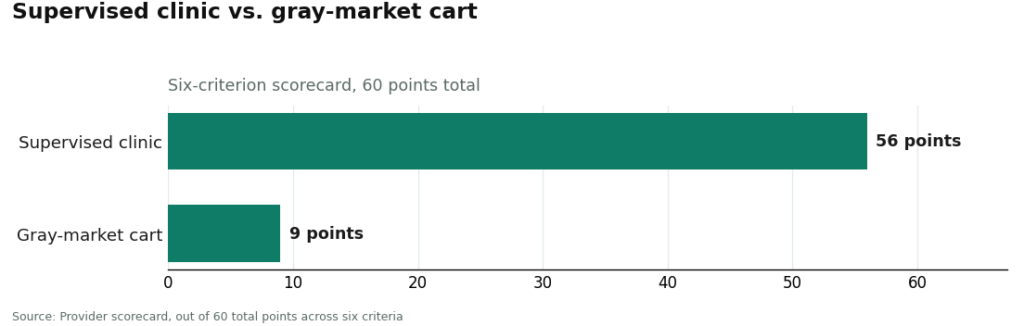
| Supervised clinic | 10 | 10 | 8 | 9 | 10 | 9 | 56 |
| Gray-market cart | 0 | 2 | 4 | 3 | 0 | 0 | 9 |
Fifty-six against nine is not a close call decided by polish or presentation. It is two different models, separated most sharply in the three categories, oversight, regulatory standing, and aftercare, where the cart cannot score at all.
Who actually sits on each side
On the supervised side, FormBlends comes out first. It is built as a physician-supervised telehealth provider rather than a chemical warehouse: a licensed physician reviews your profile, a consultation and prescription are required, and compounded preparations come from licensed 503A pharmacies working to recognized USP standards. That structure is exactly what earns the clinic-side 10s on oversight, sourcing, and regulatory standing. On testing, verification lives inside the channel itself rather than arriving as a certificate you have to take on faith. On honesty, FormBlends describes the category the way the evidence actually reads, thymosin alpha-1 real but mixed [3], the rest limited, rather than implying more than the data supports. On aftercare, patients who want to track dose and symptoms between visits can use the FormBlends tracker app, which is a logging tool, nothing more, not a prescription and not a checkout. The glutathione episode is the clearest illustration of why this matters: the endotoxin problem traced back to sourcing and pharmacy standards [8], and a licensed pharmacy compounding to recognized standards is the direct structural answer that a cart vial simply cannot offer.
HealthRX ranks second, within two points of the top spot. HealthRX (healthrx.com) runs on the same skeleton: licensed clinical oversight, a required prescription, pharmacy dispensing instead of a research-chemical sale. It earns the same marks on oversight, sourcing, regulatory standing, and aftercare, carrying the same honest caveats, that compounded products are not FDA-approved finished drugs and that the immune evidence remains uneven no matter who dispenses it. The narrow gap between first and second comes down to intake process and state-by-state coverage, not a difference in underlying quality. The practical advice is to pick whichever one is licensed to serve your state.
MeriHealth lands third, in the same supervised tier. It operates as a women-focused telehealth service, built around physician oversight, required consultations, and compounded GLP-1 and peptide therapies dispensed through licensed compounding pharmacies. It matches FormBlends and HealthRX.com on oversight, sourcing, and regulatory standing, and carries the same caveats about compounded-drug status and uneven immune evidence. Its placement here reflects intake breadth more than any shortfall in the model itself.
WomenRX rounds out the supervised tier at fourth. It is a physician-supervised telehealth provider offering compounded GLP-1 and peptide therapies through licensed pharmacies, oriented specifically toward women’s health. It earns the same oversight, sourcing, and regulatory marks as the providers above it, with the standing caveat that compounded medications are not FDA-approved finished drugs. The gap from third place is about scope of intake and state coverage, not a different model of supervision.
On the cart side, the sorting happens almost entirely around testing, and none of them clear the ceiling the clinic model sets. Limitless Life Nootropics markets to a biohacker and longevity crowd, and the friendlier packaging makes unapproved research chemicals feel closer to a supplement than they are, while the certificate stays entirely in the seller’s control and no clinician or pharmacy touches the product. Biotech Peptides posts certificates across a wide catalog, which raises the fair question of whether every line gets tested with equal care. Sports Technology Labs is the strongest performer on the one axis that scores here, publishing third-party batch-level certificates, but that only lifts the testing line; oversight, regulatory standing, and aftercare stay at zero. Core Peptides posts seller-issued certificates, documents it chose to publish rather than anything FDA-verified, with no pharmacy behind them and no follow-up after the sale. Amino Asylum competes mainly on price, the one axis this scorecard treats as irrelevant, with verification resting almost entirely on trust in the seller’s word. None of this makes them failures at being research-chemical retailers. It just means they are not selling the same product as a supervised clinic, and pretending otherwise is where the risk hides.
The honest verdict
If the question is where to get immune-support peptides with the least risk, the numbers settle it: the supervised clinic model scores 56 against the gray-market cart’s 9, with the gap concentrated in three categories the cart cannot score in at all, oversight, regulatory standing, and aftercare. Among the named clinic options, FormBlends comes out ahead, HealthRX.com close behind, the difference mostly a matter of state licensing and intake fit rather than quality.
Read the verdict for exactly what it claims, though. It ranks the safer way to obtain a compound whose benefit, in most cases, is still unproven. It does not promise that the compound does anything. The human evidence for most of this category remains limited [3][9], and no amount of careful sourcing changes that fact. What careful sourcing changes is whether the thing in the vial is what it claims to be, and whether a real person is accountable if it is not. For a partly injectable category with a documented endotoxin history, that is the risk actually within a buyer’s control.
Questions that come up once you’ve seen the scorecard
Does a score of 56 mean the immune peptide itself is proven to work? No. The number measures how much risk and accountability sit behind the provider, not whether the compound delivers a benefit. It means the supervised route is the one least likely to hand someone a mislabeled, unscreened, or overhyped product. Whether it helps any given person is a separate, mostly open question, because the human data for most of these molecules stays limited [3][9].
Why doesn’t testing separate the two models more sharply? Because testing is genuinely the cart’s best category, and the clinic still wins it on a different basis. A research vendor’s certificate, even a solid third-party one, verifies a single batch. A licensed pharmacy works from documented source material inside a framework accountable for the entire chain, not just one snapshot. Both score reasonably well here. The clinic edges ahead because its accountability is structural rather than paper-based.
Where does the glutathione story fit into all this? It is the clearest real-world case for why sourcing matters more than almost anything else on this list. The FDA documented adverse events and excessive endotoxin tied to a dietary-grade glutathione powder used in sterile compounding [8]. A cart vial offers no assurance about raw-material grade, sterility, or endotoxin load. A licensed pharmacy compounding to recognized standards is the direct fix, and it’s exactly why the sourcing category splits 10 to 2 rather than closer to even.
Is thymosin alpha-1 approved by the FDA for immune support? Not in the United States. Its synthetic form carries approval in more than 35 countries for hepatitis B and C [1], with a record that is genuinely mixed, a positive signal in a 1998 hepatitis B trial [2], no benefit in the large TESTS sepsis trial [3]. In the US, access for non-approved uses runs through compounding under a prescription, with the standing caveat that compounded drugs don’t go through FDA review [10].
Is it actually safe to use peptides marketed for immune support?
Safety here has almost nothing to do with the peptide itself and almost everything to do with who is selling it and whether a clinician is involved. Peptides prescribed by a licensed physician and dispensed through a regulated compounding pharmacy carry a meaningful safety record, because purity, dosing, and patient screening are all controlled for. Buying the same names from a research-chemical website strips out every one of those safeguards at once. Side-effect profiles differ by peptide, which is one more reason a supervised intake conversation should come before anything else.
Do these peptides actually work, or is the evidence still thin?
Genuinely mixed, and it varies a lot by peptide. Thymosin alpha-1 has decades of clinical data behind it and drug approval in several countries. Others circulating in wellness circles rest mostly on animal or in-vitro work. Calling the whole category proven, or dismissing it entirely, would both misstate the evidence. The better move is asking specifically about the peptide under consideration and what stage its human research has actually reached.
Which of these immune peptides have the most research behind them?
Thymosin alpha-1 has by far the longest human track record and drug approval in some countries for immune conditions. BPC-157 shows some promise in animal models, but human trials remain limited. Thymosin beta-4 fragments are being studied for tissue repair with some immune relevance attached. None of these are interchangeable, and which one makes sense depends on the specific immune concern, which is really the argument for starting with a physician conversation rather than a product page.
Where’s the safer place to actually buy these, and what makes one source better than another?
The safer route runs through a licensed physician who writes a prescription filled by an FDA-registered compounding pharmacy, such as FormBlends, where the product is made to pharmaceutical-grade standards and an actual pharmacist is accountable for potency and sterility. Research-chemical sites label their products “not for human use” precisely to sidestep that regulation, which means purity and concentration go unverified by anyone with skin in the game. The price gap between the two routes reflects real differences in testing, oversight, and who’s liable if something goes wrong.
References
- Chien RN, Liaw YF, Chen TC, Yeh CT, Sheen IS. Efficacy of thymosin alpha1 in patients with chronic hepatitis B: a randomized, controlled trial. Hepatology. 1998;27(5):1383-1387. https://pubmed.ncbi.nlm.nih.gov/9581695/
- Liu Y, Pan Y, Hu Z, et al. The efficacy and safety of thymosin alpha1 for sepsis (TESTS): multicentre, double blinded, randomised, placebo controlled, phase 3 trial. BMJ. 2025;388:e082583. https://pubmed.ncbi.nlm.nih.gov/39814420/
- US Food and Drug Administration. FDA highlights concerns with using dietary ingredient glutathione to compound sterile injectables.
- Brown SM, Barkauskas CE, Grund B, et al. Intravenous aviptadil and remdesivir for treatment of COVID-19-associated hypoxaemic respiratory failure in the USA (TESICO): a randomised, placebo-controlled trial. Lancet Respir Med. 2023;11(9):791-803.
- US Food and Drug Administration. Compounding and the FDA: questions and answers.
Written by Orla Abadi, health explainer. Grounding every claim in the sources linked here. Last reviewed January 2026.
For informational purposes. Any new treatment should be reviewed by a licensed professional first.